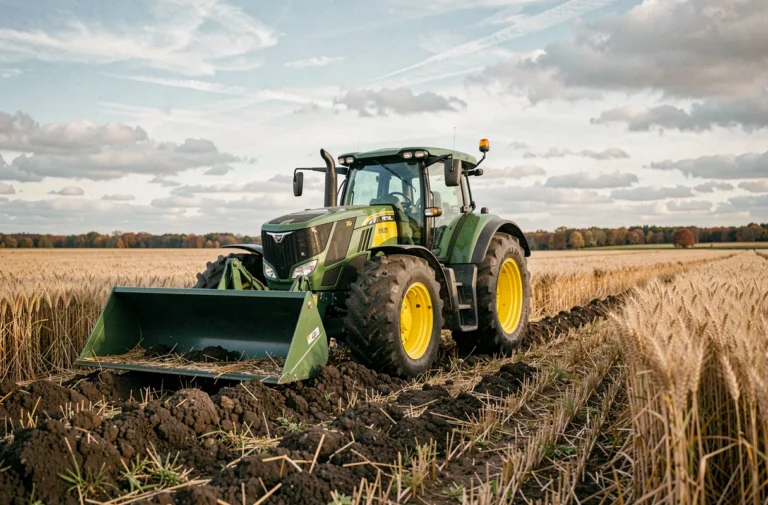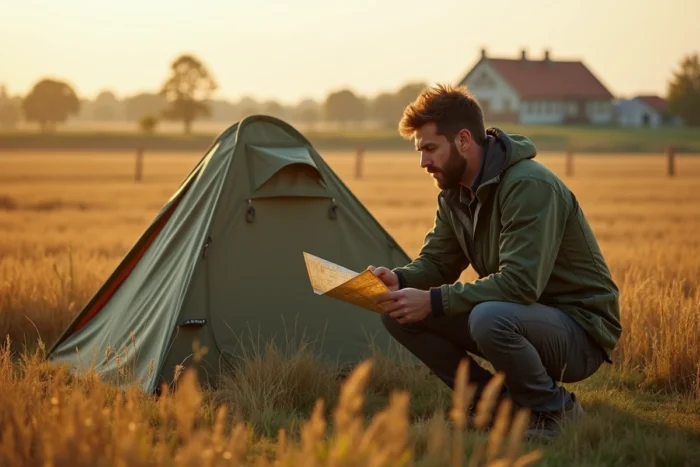
In French law, sleeping on agricultural land is not prohibited in principle. Article R.111-32 of the Urban Planning Code establishes a basic freedom: camping is allowed with the consent of the person who has possession of the land, outside of public roads and pathways. This rule also applies to a parcel classified as agricultural land. The difficulty arises when the stay exceeds a few nights or when a semi-permanent structure is installed.
The three-month rule: triggering threshold on agricultural land
The technical point that most campers are unaware of relates to a specific article of the Urban Planning Code: Article R.421-23. As soon as an installation (tent, caravan, converted van) remains for more than three months per year on the same land, a prior declaration to the town hall becomes mandatory, even on non-buildable land.
Below this threshold, the stay remains legal as long as there is written or verbal consent from the owner. This framework applies equally to a hiker who pitches their tent for a night and to a van-lifer who parks for a few weeks on a farmer’s parcel. To delve deeper into the regulatory subtleties, one can read on Guide Immo a file that details the obligations zone by zone.
Beyond three cumulative months in the year, the absence of a declaration exposes one to a report of violation of the Urban Planning Code. The sanction targets both the occupant and the landowner who gave their consent without formalities.

Zone A of the PLU: what agricultural classification really prohibits
A plot classified as zone A (agricultural) in the PLU is reserved for agricultural activities. In practical terms, any construction or development that does not directly serve the operation is prohibited. Pitching a tent for a few nights does not constitute a development, which is why occasional camping remains tolerated.
The situation changes radically when it comes to permanent installations. Installing a mobile home, a light recreational dwelling (HLL), or even a permanent caravan on agricultural land amounts to creating a use that is not compliant with the land’s intended purpose. The municipality’s PLU may provide for exceptions, but these are rare and regulated.
Mobile home and caravan: two distinct regimes
The confusion between caravan and mobile home traps many owners. A caravan retains its means of mobility (wheels, axle) and falls under parking, not construction. A mobile home, classified as mobile recreational residence, can only legally be parked in a declared campsite, a residential leisure park, or a classified holiday village.
Removing the wheels from a mobile home to install it on agricultural land does not transform it into an authorized construction. This practice, sometimes presented as a trick, actually exposes one to a formal notice to restore the land.
Camping on a farm: a status that does not exist in law
The term “farm camping” suggests a specific legal regime. In reality, no text defines farm camping as a legal category. It refers to a declared campsite, subject to the Urban Planning Code and the Tourism Code, located on a farm.
For a farmer to legally host campers, the cumulative conditions are precise:
- The land is limited to six pitches or a maximum of twenty people to remain under the simple declaration regime at the town hall
- Beyond this threshold, a development permit becomes mandatory, with a technical file and sometimes an impact study
- The operator must be affiliated with the agricultural social regime when operating this campsite as part of their agricultural activity
- The land must comply with basic health regulations (access to water, waste management)
A farmer who hosts tents without declaration takes a real risk. Inspections remain infrequent in rural areas, but a neighbor’s complaint or an accident on the land can trigger a procedure.
Sleeping on agricultural land in practice: the precautions that matter
The legality of occasional camping on agricultural land depends on a few concrete checks that the camper can make before settling in.
- Obtain explicit consent from the owner or operator, ideally in writing even for just one night
- Check that the parcel is not located in a prohibited area (protected zone, classified site, coastline within the hundred-meter band, surroundings of a historical monument)
- Ensure that the stay does not exceed three cumulative months in the year to avoid the obligation of prior declaration
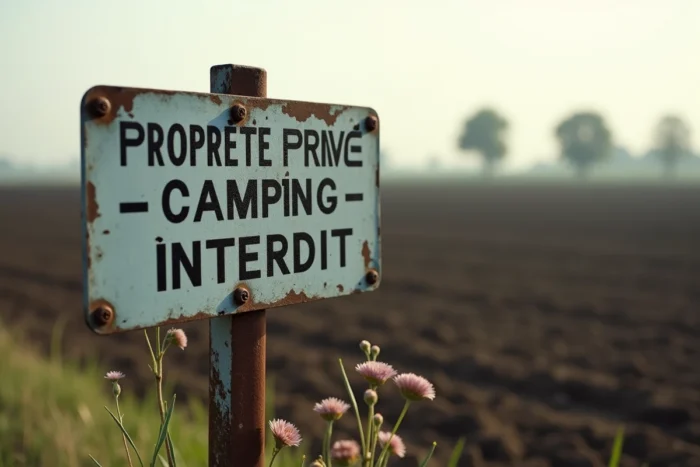
The owner’s consent does not exempt from compliance with local prohibitions. Some municipalities issue municipal orders prohibiting camping outside designated sites, including on private agricultural parcels. These orders are available for consultation at the town hall.
Bivouac versus camping: a blurry but real boundary
Bivouacking, defined as a light camp set up from sunset to sunrise, enjoys broader tolerance than prolonged camping. On agricultural land, bivouacking for a night with the owner’s consent generally poses no legal issues.
The boundary shifts as soon as a structure is added (rigid awning, ground slab, electrical connection). Each fixed element brings the installation closer to a development subject to urban planning authorization.
The most reliable criterion for a camper remains the total reversibility of the installation. If the land can return to its original state in a few minutes after departure, the legal risk is minimal. As soon as a lasting trace remains, the framework changes.