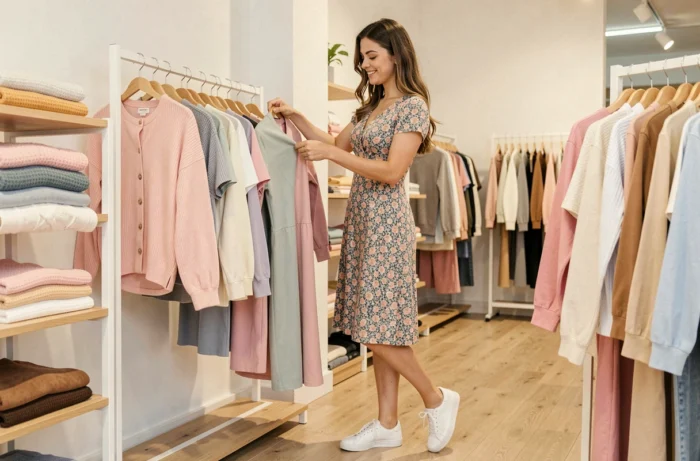
The French online women’s clothing market is undergoing a phase of restructuring. Second-hand and ultra-fast fashion now account for one quarter of clothing purchases by volume according to the French Institute of Fashion, with a particularly marked increase among 18-24 year-olds. Between the rock-bottom prices of Shein or Temu and the rise of Vinted, online shops focused on affordable women’s fashion must deal with unprecedented pressure on their margins and attractiveness.
Pressure on the mid-range: what market figures reveal
The 2025-2026 data compiled by Syndex and reported by the Gazette des Commerçants indicate a decline in the clothing market in value and volume, extending a trend that began before Covid. The shift is occurring in two opposing directions: towards very low-cost (imported ultra-fast fashion) and towards second-hand (peer-to-peer resale platforms).
Ultra-discount fast fashion sites are already capturing several points of market share by volume. This phenomenon directly compresses the economic space of online shops that offer trendy clothing at moderate prices, unable to match such low rates.
For consumers, the determining factor is no longer the lowest price, but the perceived value for money. A garment priced at 25 euros that lasts three seasons is more appealing than a piece at 8 euros worn twice.
Affordable trend shops that document the quality of their products (composition, finishes, customer feedback) maintain a loyal audience. Those that merely multiply promo codes are losing ground to discount giants, which can be easily found via good deals on Nos Idées Shopping and other specialized aggregators.

Online women’s fashion shop: the criteria that make a difference
The competing catalogs analyzed (Stand-Privé, Cache Cache, Place des Tendances, La Modeuse, Helline) share a common point: they focus on the volume of references and recurring promotions. Differentiation by price alone no longer works when all brands display permanent discounts.
Three axes distinguish the shops that are gaining notoriety from those that are stagnating:
- Editorial curation: offering short thematic selections (ten pieces for a weekend in the city, five color combinations for back-to-school) rather than a catalog of several thousand references without hierarchy.
- Transparency on manufacturing: clearly stating the country of production, the exact composition of fabrics, and return conditions. Field returns show that this level of detail reduces the product return rate.
- Optimized mobile experience: the majority of women’s fashion purchases are made from a smartphone. A slow loading time or a complex payment tunnel is enough to lose a customer to a competing app.
Shops that combine these three elements manage to retain a clientele that price alone would not have kept.
Women’s fashion trends 2026: what is actually selling online
The autumn-winter 2026 collections spotted at Zara, COS, and several French brands converge on a few directions. The return of structured cuts (fitted blazers, pleated trousers) coexists with more casual pieces inherited from remote work.
Earthy colors and muted tones dominate the new collections, breaking away from the bright shades that characterized previous seasons. Denim remains a staple, available in bermudas, jumpsuits, and oversized jackets, as confirmed by the highlights from La Modeuse and Cache Cache.
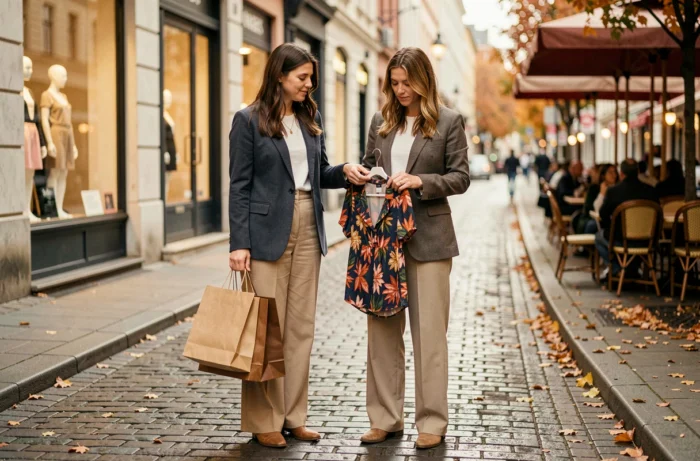
For an online shop positioned in the affordable segment, the choice of pieces offered matters more than their number. A tight selection of clothing aligned with the actual trends of the season generates more conversions than a plethora of catalog items where the customer gets lost.
The trap of constant renewal
Some online shops attempt to replicate the pace of ultra-fast fashion by adding hundreds of new references each week. This strategy poses a logistical problem (inventory management, return costs) and muddles the brand’s identity.
The available data do not allow for a conclusion on an appropriate renewal pace. However, brands that communicate about limited-time capsule collections show higher engagement rates on social media compared to those that flood their catalog.
Prices, creators, and second-hand: the boundaries blur
A recent phenomenon complicates the reading of the market: the boundary between affordable new and premium second-hand is fading. A designer dress resold on Vinted for 30 euros directly competes with a new piece from an online shop at the same price. Oxfam’s report on solidarity reuse confirms this growing porosity between the circuits.
For trendy online shops, the response does not lie in a price war. It lies in building a recognizable identity: assertive editorial choice, storytelling about products, personalized customer relations.
Physical stores like Cache Cache retain the advantage of trying on and immediate pickup. Pure web players compensate with rich visuals, detailed size guides, and verified customer reviews.
The market for affordable women’s fashion online has not shrunk. It has fragmented among players with very different models. The shops that will survive this restructuring are those that have managed to precisely define their positioning between fast fashion and creators, without trying to occupy all segments at once.