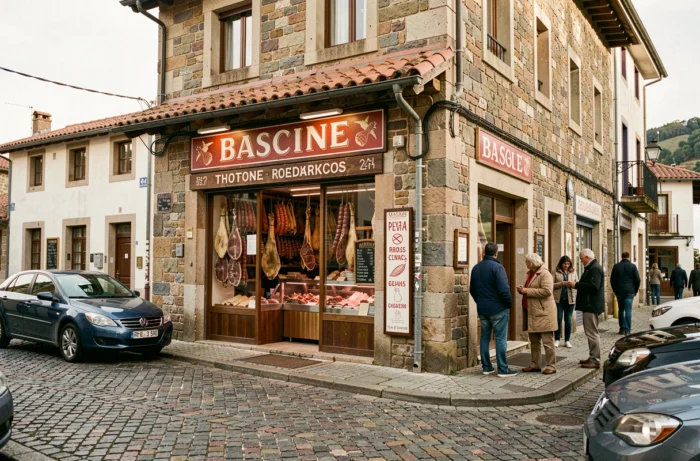
Dancharia (Dantxarinea on the Spanish side) attracts thousands of French visitors every week from the Basque Country and beyond. The local butcher shop, part of the Venta Peio complex, draws a significant share of interest from first-time visitors. However, the experience on-site varies greatly depending on the day, arrival time, and prior preparation. This article measures the concrete discrepancies between what one expects from a first visit and what one actually finds there.
Hours and Crowds at Dancharia: The Time Slots That Make All the Difference
The time factor influences the quality of the visit much more than the choice of products. The ventas of Dancharia, including the butcher shop, operate with open 7 days a week, including Sunday afternoons. The usual time slots range from 9 AM-10 AM to 7 PM-8 PM on weekdays.
| Day | Indicative Opening | Butcher Shop Crowds | Availability of Cuts |
|---|---|---|---|
| Monday-Friday (morning) | 9 AM-10 AM | Low to moderate | Maximum |
| Saturday morning | 9 AM-10 AM | High from 10:30 AM | Good before 11 AM |
| Saturday afternoon | Until 7 PM-8 PM | Moderate | Reduced on certain cuts |
| Sunday | From 10 AM or 2 PM depending on the season | Variable | Limited at the end of the day |
Sunday remains the most unpredictable time slot. Early closures out of season occur without systematic communication on the French side. Spanish public holidays (which do not correspond to French public holidays) also alter the time slots. Checking the store’s social media the day before can prevent a wasted trip.
For those looking for a review of the Dancharia butcher shop before heading there, the most frequent feedback concerns the gap between the hours posted online and the reality on-site, especially outside the summer season.
Customer Reviews of the Venta Peio Butcher Shop: An Average Rating That Masks Extremes
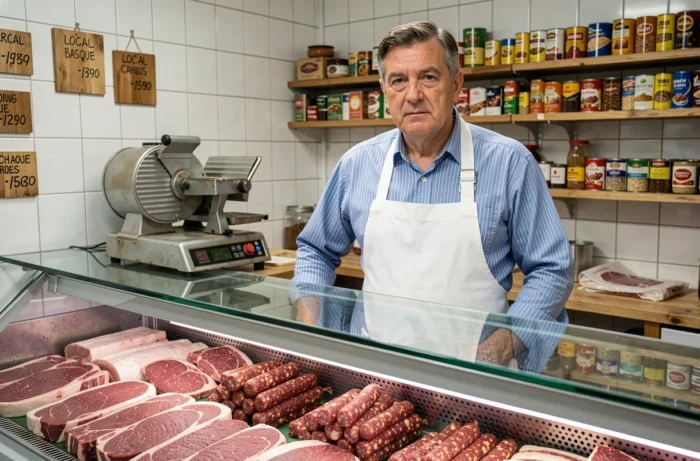
The average rating of Venta Peio on Tripadvisor hovers around 3.2 out of 5 from over 200 reviews. This figure, taken in isolation, doesn’t say much. What characterizes this place is the coexistence of “excellent” and “horrible” feedback on visits sometimes spaced just a few days apart.
What Positive Reviews Highlight
- The freshness and quality of local meats, particularly cuts of beef and Navarre lamb, regularly mentioned as superior to what is found in large supermarkets on the French side
- The value for money on large cuts (roasts, beef ribs), considered significantly better than in Bayonne or in the artisan butcher shops of the French Basque Country
- The sourcing of local meat and the short supply chain emphasized by the brand, with farms located in Navarre
What Negative Reviews Point Out
- A customer service described as rushed during peak hours, with little advice on cuts or cooking methods
- Stock shortages on the most requested cuts by late morning on Saturdays, with no restocking during the day
- A frequent confusion between the supermarket butcher section (self-service) and the dedicated butcher shop, which are two distinct spaces with different ranges
The experience varies greatly depending on the arrival time and day of the week. Visitors on Saturday mornings after 11 AM and Sunday afternoons face unfavorable factors: maximum crowds, depleted stock, and pressured staff.
Dancharia Butcher Shop and French Basque Butcher Shops: The Concrete Differences
The direct comparison between the Dancharia butcher shop and the shops in Bayonne or Saint-Jean-de-Luz focuses on three axes: price, range, and service.
Regarding price, the difference is real but not uniform. Large cuts (several kilos) show a significant differential in favor of Dancharia. However, for individual portions or fine charcuterie, the price advantage diminishes considerably once the cost of the trip is taken into account.
In terms of range, the Venta Peio butcher shop offers Spanish cuts (chuletón, pluma ibérica) that are not easily found on the French side. This is a compelling reason to visit for fans of Iberian cuisine. Conversely, classic French cuts are less well represented: flank steak, hanger steak, or sirloin are not always available under the usual names.
As for service, French artisan butcher shops provide personalized support (cooking advice, maturation choice, custom cutting) which remains their main advantage. In Dancharia, the volume of customers handled daily does not allow for this level of advice, especially during peak times.
Regulations and Crossing the Border with Meat
The passage of food products between Spain and France within the Schengen area does not pose a customs issue for personal quantities. There is no systematic control at the Dancharia border for foodstuffs intended for private consumption.
The real constraint is logistical: maintaining the cold chain during the return trip. For visitors coming from Bayonne (about thirty minutes by car), the risk is limited. For those making a one to two-hour drive, a cooler with ice packs becomes necessary, especially in summer.
Traffic on the road leading to Dancharia, particularly the D4 on the French side, experiences marked slowdowns on Saturday mornings and during long weekends. Planning to leave before 9 AM from Bayonne allows for arrival at opening time and departure before the peak reverse traffic late in the morning.
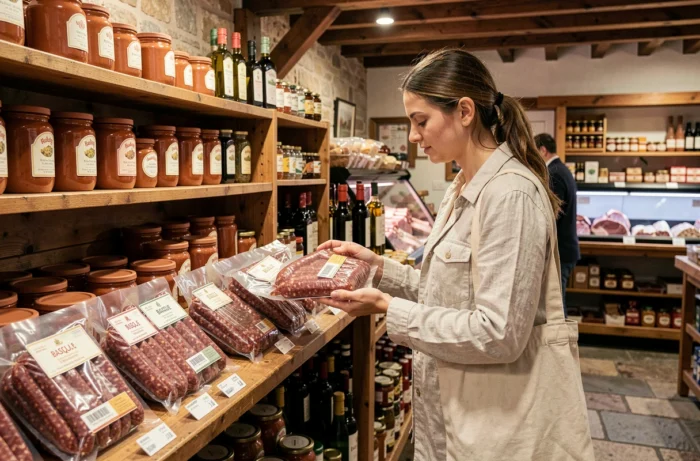
The first visit to Dancharia for its butcher shop should be prepared like any targeted grocery purchase: by identifying the desired cuts, choosing a low-crowd time slot, and planning the appropriate transport equipment. The rating of 3.2 out of 5 reflects less the intrinsic quality of the products than the management of crowds and the sometimes poorly calibrated expectations of first-time visitors.