Musical voice cloning relies on voice-to-voice conversion (SVC) models trained on mel-spectrogram representations. Before launching any tool, the quality of the input dataset determines the entire outcome. Understanding the technical chain, from audio pre-processing to model fine-tuning, prevents the mediocre results produced by most “one-click” workflows.
Audio Pre-processing and Stem Extraction Before AI Voice Cloning
An SVC model never works on a complete stereo mix. It requires an isolated vocal track, free from residual reverb or compression artifacts. Source separation (stem splitting) thus constitutes the first real step in the process.
Neural separators like LALAL.AI or Demucs v4 cut an audio file into distinct stems (vocals, drums, bass, instruments). The extracted vocal track then serves as a training target or conversion source. A noisy vocal stem directly degrades the fidelity of the cloned timbre.
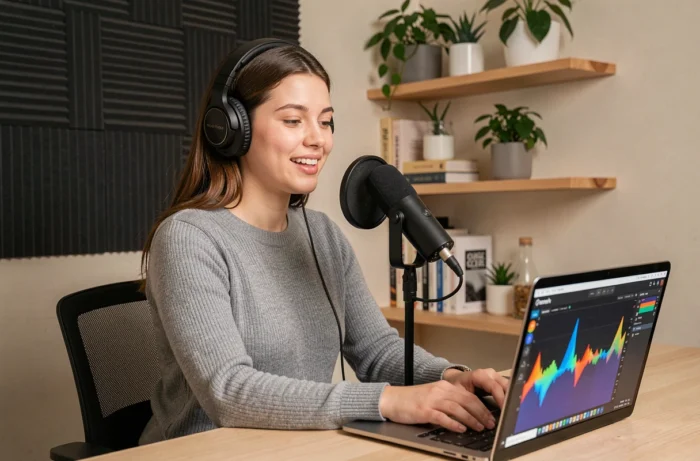
We recommend recording the source vocal sample in an acoustically treated environment, in WAV format at a minimum of 48 kHz / 24 bits. Compressed formats (MP3, OGG) remove harmonics in the high frequencies, which impoverishes the resulting vocal model. To put your voice on music with AI convincingly, the source signal must cover the full dynamic range of the voice, from whispered passages to sustained notes at full power.
- Minimum usable sample duration: several minutes of varied singing covering different registers (bass, mid, treble) and intensities
- Eliminate silences longer than two seconds, mouth noises, and overly pronounced breaths before training
- Normalize the RMS level of the file so that the model does not overweight loud passages at the expense of nuances
SVC Architecture and Fine-tuning a Custom Vocal Model
The choice of the SVC engine determines the achievable quality ceiling. Open-source architectures like RVC (Retrieval-based Voice Conversion) and So-VITS-SVC use different approaches to map the source timbre to the target timbre.
RVC operates by searching for embeddings in a pre-trained latent space. The advantage: fast training, even on consumer GPUs. The downside: rapid transients (plosive consonants, note attacks) can sound artificial if pitch tracking is not finely calibrated.
So-VITS-SVC offers more granular control over pitch and energy, at the cost of significantly longer training time. The result depends less on the tool than on the quality of the dataset and the number of training epochs.
Critical Parameters During Training
The learning rate must be gradually reduced to avoid overfitting, which manifests as a “flat” synthetic voice losing the natural micro-variations of timbre. We observe that a singing dataset covering at least three octaves produces more stable conversions than a dataset limited to a narrow range.
The f0 (fundamental frequency) is the most sensitive parameter. A poor pitch extraction algorithm (CREPE, Harvest, DIO) can shift notes by a quarter tone, making the result unusable on a final mix. Testing several f0 extractors on the same sample allows you to identify the one that best matches the specific vocal grain.
Legal Risks of AI Voice Cloning in France
The technical dimension does not exempt from legal analysis, which has radically changed since 2024. The SREN law of March 21, 2024, introduced the offense of hyper-manipulation into the Penal Code, applicable to AI voice cloning used without consent.
In practical terms, cloning someone else’s voice (artist, collaborator, relative) to place it on music without written permission is no longer just a matter of copyright or neighboring rights. It is a potential criminal liability. The voice is now recognized as an attribute of personality, meaning that an identifiable person in an AI-generated voice can sue even without proving a reproduction of an existing recording.

Consent and Contractual Clauses
For a musical project using voice cloning, we recommend formalizing in writing the scope of use of the vocal model: authorized media, duration, exclusivity or not, right of withdrawal. These clauses did not exist in traditional artist contracts and must be added specifically.
Music distribution platforms are gradually integrating systems for detecting AI-generated content. A track identified as using a cloned vocal timbre without proof of consent may be automatically removed or even trigger a Content ID report.
Mixing and Post-processing an AI Voice on Instrumental
Obtaining a converted vocal stem is not enough. Integration into a musical mix requires specific processing that public tutorials systematically overlook.
Voices converted by SVC often exhibit a spectrum that is too smooth between 2 kHz and 6 kHz, the vocal presence zone. A light corrective EQ in this range, combined with subtle harmonic saturation, restores the perception of “reality” of the timbre.
- Apply a targeted de-esser: sibilants are frequently amplified by the conversion process
- Work on reverb separately from the converted signal to avoid amplifying the residual artifacts of the model
- Automate the volume phrase by phrase rather than aggressively compressing, as compression accentuates the background noise inherent to synthetic voices
The last recurring pitfall concerns timing. SVC models sometimes introduce variable latency of a few milliseconds on certain syllables. Manually aligning the converted vocal track to the project’s rhythmic grid remains a step that automation does not yet reliably replace.
The complete chain, from raw vocal dataset to finalized mix, requires a level of production rigor augmented by machine learning skills. Tools simplify access, but the professional result demands human oversight at every step of the conversion.