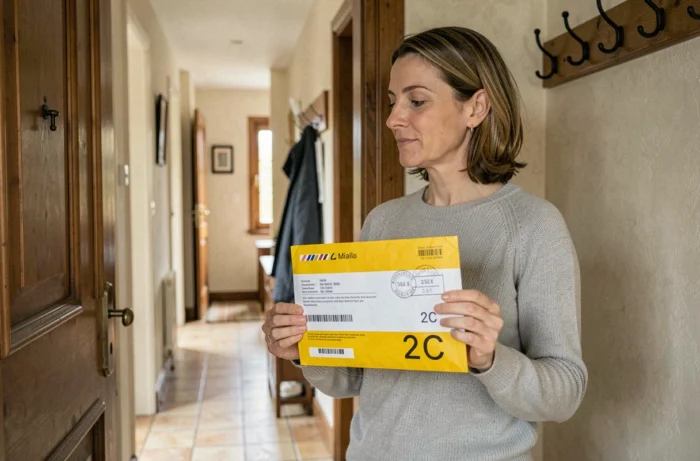
A registered letter with a tracking number starting with 2C indicates a delivery with acknowledgment of receipt, deposited at the La Poste counter. This prefix does not reveal the name or nature of the sender. Identification remains impossible until the letter has been handed over to the recipient, with a signature as proof.
This postal constraint, often a source of concern, raises a question more useful than mere curiosity: what information can actually be utilized before picking up the mail, and what legal consequences arise from the choice to retrieve it or not?
Legal evidence available before opening the 2C registered letter
Most guides focus on the identity of the sender. The more strategic question is what the recipient knows, and can prove, even before opening the envelope. Because the registered letter produces legal effects as soon as it is presented, not just upon its opening.
The delivery notice left in the mailbox mentions the pickup office, the presentation date, and the references of the shipment. It does not include the sender’s name. The online tracking, accessible via the number starting with 2C, may indicate the originating post office, which sometimes provides a geographical clue, but nothing more.
These elements nonetheless constitute a dated record. The date of the first presentation of the registered letter triggers the start of certain legal deadlines (disputing a rental notice, opposing an administrative decision). Knowing how to find out where a 2C registered letter comes from helps refine hypotheses, but the only legal certainty exploitable at this stage remains the presentation date itself.
Keeping the delivery notice, noting the date, and checking the online tracking before going to the post office is therefore not an insignificant reflex. These elements serve as proof if a dispute arises regarding the withdrawal period.

2C prefix of the tracking number: what it really indicates about the sender
The tracking number of a postal registered letter starts with two characters that inform about the type of shipment. The prefix 2C corresponds to a registered letter with acknowledgment of receipt manually deposited at the counter. It is distinguished from other common prefixes:
- 2C: registered letter with acknowledgment of receipt, deposited at the counter by an individual or a professional.
- 2D: registered letter without acknowledgment of receipt, less common, used when the sender does not need signed proof of receipt.
The prefix 2C does not filter the category of sender. An individual, a bank, a landlord, a court, a tax administration, or an employer can all send a 2C registered letter. The code indicates the mode of sending, not the identity of the sender.
Some sites suggest deducing the sender from the originating office displayed in the tracking. This approach remains very approximate: a law firm located in a large city may use the same post office as thousands of individuals. The originating office restricts the geographical area, nothing more.
Retrieve, refuse, or let the deadline pass: concrete consequences
Faced with a 2C registered letter whose sender remains unknown, three options are available. Each produces different legal effects, and this is where the reflection should focus rather than solely on identifying the sender.
Not retrieving the registered letter does not protect the recipient. Under French law, a registered letter presented and then returned to the sender after the retention period is considered to have been brought to the recipient’s attention. Courts take the date of first presentation as the starting point for deadlines for contestation or response.
Refusing the registered letter at the time of delivery produces the same effect. The refusal is noted on the acknowledgment of receipt and returned to the sender, who then has proof that the recipient was informed of the existence of the mail.
Therefore, retrieving the registered letter remains the only option that provides access to the content and allows for an informed response. If the mail contains a formal notice, a termination notice, or an administrative decision, the recipient retains the ability to exercise their rights within the allotted time.
- If the content requires a response within a certain timeframe, this timeframe often starts from the first presentation, not from the actual retrieval.
- In case of doubt about the nature of the mail, quick retrieval allows consulting a legal professional before the expiration of any potential contestation deadline.
- The receipt of retrieval, signed at the post office, serves as proof of the date on which the recipient actually took possession of the letter.

Electronic registered letter and paper registered letter 2C: a difference in identification
The qualified electronic registered letter, offered by La Poste and other providers, operates on a principle opposite to that of the paper registered letter. The sender must be identified and authenticated before sending, meaning that the recipient knows the identity of the sender as soon as they receive the notification.
With a paper registered letter 2C, this transparency does not exist. The recipient receives an anonymous delivery notice and only discovers the sender at the moment of the physical handover of the letter. This asymmetry is not a flaw in the postal system: it results from the historical operation of paper mail, where the sealed envelope guarantees the confidentiality of the content and the sender until delivery.
For professionals who regularly receive registered letters, switching to electronic registered letters eliminates this phase of uncertainty. The recipient knows who is writing before deciding to open the message. This difference can influence the choice to accept or contest the receipt.
The 2C prefix on a delivery notice remains a limited indicator. The date of first presentation, the originating office, and the type of shipment are the only exploitable data before retrieval. The decision to retrieve or not the letter should be based on these factual elements, rather than an attempt to guess the identity of the sender, which will remain unknown until the envelope is opened.