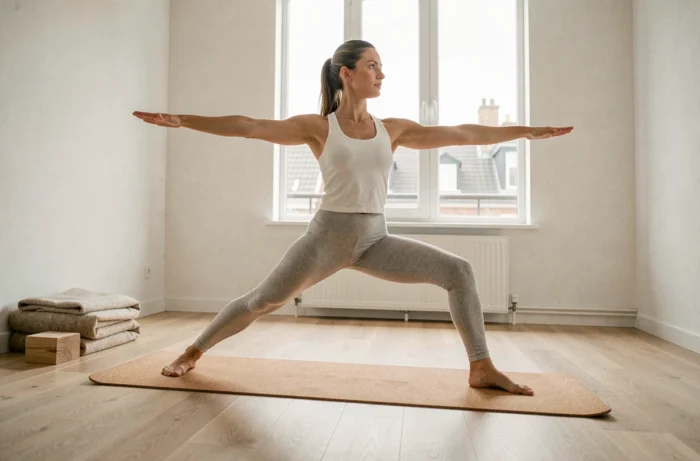
Creating your own yoga sequences requires understanding how the families of postures interact with each other. A table of postures categorized by family is not enough: the logic of sequencing relies on the order in which the body is engaged, the biomechanical transitions between each asana, and the goal of the session.
Sequencing by goal: mobility, recovery, or activation
Most tables of postures available online categorize asanas by family (standing, seated, inversions, restorative). This classification is useful for identifying a posture, but not for building a coherent sequence.
An effective flow starts from a specific goal. A session focused on joint mobility does not follow the same progression as a post-effort recovery session or a morning activation sequence. The table below provides a framework by goal, with the families of asanas to prioritize in each phase of the session.
| Session Phase | Mobility Goal | Recovery Goal | Activation Goal |
|---|---|---|---|
| Opening (5-10 min) | Ground postures, gentle spinal flexions | Restorative postures, slow breathing | Dynamic standing postures, salutations |
| Main Body (15-30 min) | Hip openers, seated twists, low lunges | Long forward bends, postures supported by props | Warriors, balances on one leg, planks |
| Peak Intensity | Deep extension postures (pigeon, lizard) | No increase in intensity, passive hold | Short inversions, held downward dog |
| Return to Calm | Ground twists, seated forward bend | Child’s pose, extended savasana | Gentle twists, savasana |
This breakdown into phases allows for choosing postures not in isolation, but based on their role in the sequence. A pigeon pose placed in the opening does not have the same effect as when placed after deep lunges.
The resource available on the website www Art de Guérir organizes postures by family of asanas with this flow-building logic.
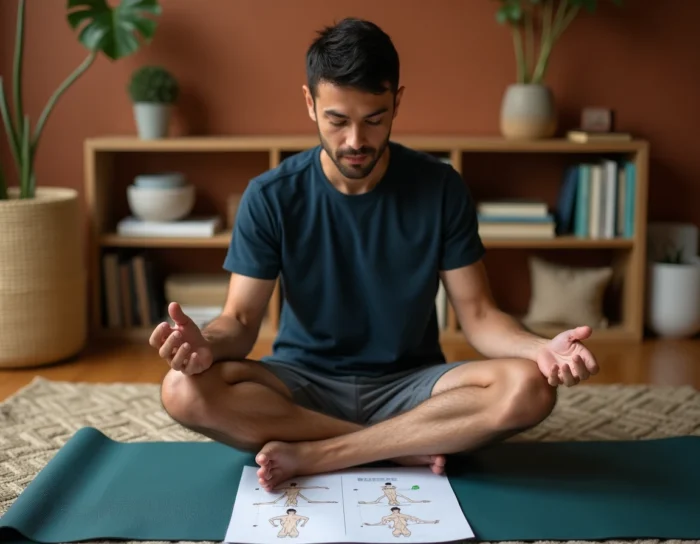
Biomechanical transitions between families of postures
A fluid sequence relies on transitions that respect the body’s logic. Moving from a standing posture to a ground posture without an intermediate transition forces a “break” in the movement. Each transition should follow a natural line of movement, which avoids micro-joint compensations.
Recent training in yoga sequencing now incorporates fascial lines as a criterion for progression. The idea is to work a muscle chain continuously rather than engaging isolated groups.
Compatible sequences by family
- Standing to ground: moving through a low lunge or downward dog allows for descent without breaking the posterior chain
- Forward bends to twists: the spine is already in a low neutral position, the twist naturally begins from the thoracic vertebrae
- Extensions (cobra, camel) to compensatory bends: always intersperse a neutral posture (table or child) to relieve the lower back before bending in the opposite direction
- Inversions to restorative postures: descend via an intermediate posture (supported bridge, legs up the wall) to avoid a too abrupt venous return
This transition logic is what distinguishes a constructed sequence from a simple list of postures executed one after the other.
Building a reproducible flow with a simple notation format
Digital course planning tools now allow for creating reusable, printable, and shareable sequences. A reproducible flow is notated like a score: each posture is associated with a duration of hold, a side (left/right), and a transition indication.
A simple format for noting a sequence on paper or in a spreadsheet:
| Posture (sanskrit) | Posture (French) | Duration / breaths | Transition to next |
|---|---|---|---|
| Adho Mukha Svanasana | Downward Dog | 5 breaths | Step forward, right foot |
| Virabhadrasana I | Warrior I | 5 breaths | Hip opening, arms extended |
| Virabhadrasana II | Warrior II | 5 breaths | Hand to the ground, twist |
| Utthita Parsvakonasana | Extended Side Angle | 5 breaths | Return to downward dog |
This type of notation makes the sequence transferable. A teacher can share it with a colleague, and a practitioner can follow it alone at home without a video.
Adapting the duration of holds to the goal
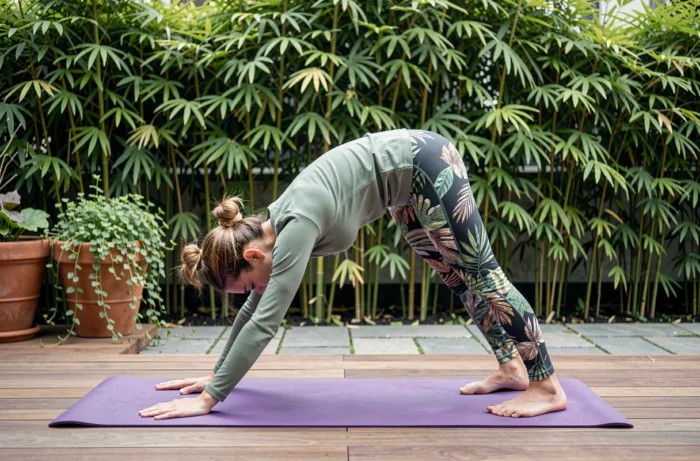
For a mobility goal, long holds of eight breaths or more allow connective tissues to gradually release. For an activation session, short holds of three to five breaths keep the heart rate slightly elevated.
In recovery, the hold can exceed several minutes per posture, especially in restorative asanas supported by props (bolsters, blocks, straps).
Yoga postures for beginners: how to start a personal sequence
A beginner practitioner does not need to master dozens of postures to build a flow. A sequence of six to eight postures already covers the main families: a standing balance posture, a forward bend, a gentle extension, a twist, a hip opener, and a final restorative posture.
A common pitfall is wanting to replicate long sequences seen in group classes. These sequences are designed for a heterogeneous group and include variations that do not always correspond to an individual goal.
- Start with a short sequence (maximum twenty minutes) with postures that can be held without pain or compensation
- Add one posture per week rather than changing the entire sequence
- Systematically note sensations after each session to adjust hold durations and transitions
Alignment in each posture matters more than the number of postures. A sequence of six well-executed asanas produces more effects than a flow of twenty rushed postures.
Building a personal sequence is an iterative process. The posture table serves as a reservoir, not a program to follow line by line. It is the combination of goal, transitions, and duration of holds that transforms a list into practice.