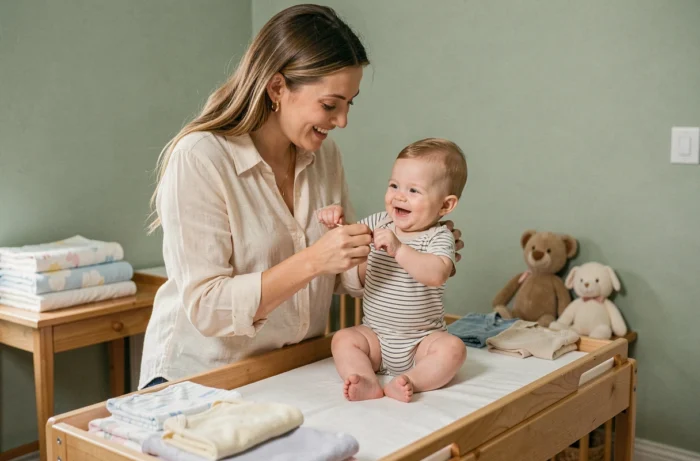
Dressing a baby daily involves balancing two requirements that are not as opposed as one might think: physiological comfort and visual appeal. An infant’s body poorly regulates its temperature, its skin reacts quickly to friction and chemicals, and its movements require total freedom. Starting from these technical constraints allows for clothing choices that are both suitable and stylish.
Textile fibers for babies: cotton, merino wool, and linen put to the test
The choice of material dictates everything else. A well-cut garment made from an unsuitable fiber will cause irritation or overheating, regardless of its appearance.
Organic cotton remains the reference fiber for pieces worn directly against the skin: bodysuits, pajamas, underwear. Its absorbency limits moisture, and its tight weave withstands frequent washing without losing shape. Opt for a sufficiently dense weight to avoid transparency after a few cycles in the washing machine.
Merino wool, long reserved for winter clothing, is now available in fine knits suitable for autumn and transitional seasons. Its thermoregulating fibers keep the baby warm without causing overheating. Check that the Oeko-Tex certification or equivalent is on the label, as some anti-felting chemical treatments can irritate sensitive skin.
Linen is suitable for hot days due to its quick-drying properties. Its initial stiffness relaxes with washing. However, it wrinkles easily, which may discourage parents who prefer a neat appearance. Pairing it with a cotton bodysuit underneath remains the most practical combination for summer months.
The catalogs available on lesbebesfringueurs.fr allow for comparisons of these materials on concrete pieces, from basic bodysuits to second-hand outfits.
Layering system: dressing baby without a complete change
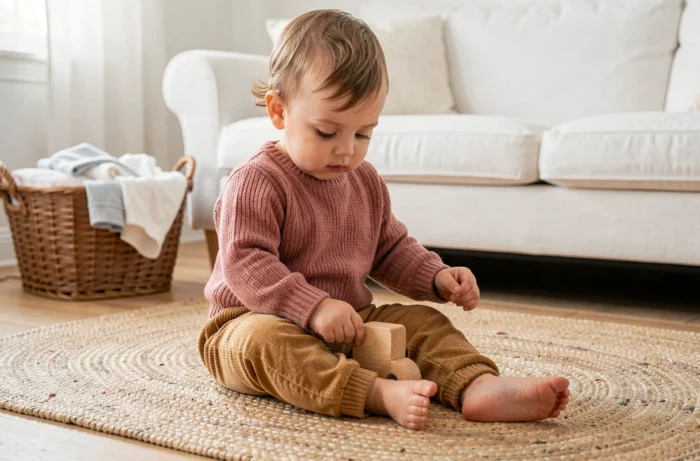
Layering thin layers works better than a single thick layer. The principle is simple: each layer serves a distinct purpose (absorption, insulation, outer protection), and you remove or add one according to the ambient temperature.
Base layer: the bodysuit
A short or long-sleeved cotton bodysuit serves as the first layer. It remains in direct contact with the skin, absorbs sweat, and keeps the diaper in place. Choose models with snap closures at the crotch: changing remains quick without fully undressing the baby.
Middle layer: the main garment
Overalls, dungarees, or a top-and-pants set depending on the season. This piece carries the overall look of the outfit. Fabrics like thick jersey in autumn or lightweight fleece in spring offer a good compromise between style and practicality.
Outer layer: occasional protection
A knit cardigan, buttoned cardigan, or lightweight jacket can be removed in seconds when the temperature rises. Two thin layers are better than a single thick garment that will need to be completely removed inside a store or restaurant.
- Below 15 °C: long-sleeved bodysuit + overall + jacket or coat, hat, and thick socks
- Between 15 and 22 °C: short-sleeved bodysuit + soft pants or dungarees + lightweight cardigan within reach
- Above 22 °C: bodysuit alone or short-sleeved bodysuit + cotton shorts, bare feet in the stroller if it is in the shade
Cuts and closures: what makes baby clothing truly practical
A garment may look beautiful on a hanger but be a nightmare to put on. The cut and type of closure determine whether the outfit will stay in the daily rotation or end up at the bottom of the drawer after two tries.
Crossed necklines or side snap closures avoid having to pull the garment over the head, a motion most infants dislike. Bodysuits with American openings (wide necklines that open over the shoulders) serve the same purpose while remaining visually discreet.
Snap buttons are quicker than traditional buttons and pose no risk of ingestion if one comes loose, provided their sturdiness is checked regularly. Zippers facilitate nighttime changes (pajamas), but they require a fabric flap to protect the baby’s chin and belly from the metal.
Elastic bands at the waist of pants and dungarees ensure a secure fit without compression. Avoid rigid belts, zippered jeans, or fitted clothing that restrict crawling and rolling movements.

European GPSR regulation and labeling: what changes for baby clothing
Since December 2024, the Regulation (EU) 2023/988 on the general safety of products applies to all businesses selling children’s clothing in the European Union. It replaces the old directive 2001/95/EC and introduces concrete obligations for manufacturers and retailers.
Each product must now undergo a documented risk assessment (cords, small parts, flammability, chemicals). Brands must keep a technical file for ten years and ensure physical and digital traceability that allows tracking back to the batch and materials used. Safety information must be written in the language of the country of sale.
In practice, this means that the labeling of compliant baby clothing indicates the exact composition, country of manufacture, and care instructions in readable French. The absence of these mentions on an item sold online is a red flag. Peer-to-peer resale platforms are not subject to the same controls, making verification more difficult for second-hand clothing.
- Check for a CE marking or Oeko-Tex certification on new clothing
- Read the labels in full: composition, country of manufacture, washing instructions
- Beware of abnormally low prices on imported items without compliance documentation
Combining style and comfort daily relies less on trends than on mastering three parameters: the appropriate textile fiber for the season, modular layering, and closures that simplify changing. A garment that the parent dreads putting on will eventually not be worn, regardless of its appearance.