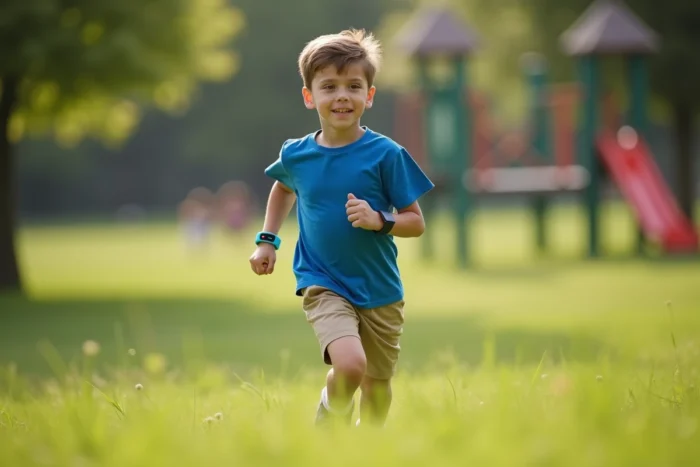
A GPS bracelet for children is chosen based on measurable criteria: location accuracy, battery life, physical resistance of the case, and actual cost over a year (device plus subscription). Comparing these parameters among the main categories of devices allows for quickly ruling out models unsuitable for a child’s daily life.
Smartwatch, case, or simple GPS bracelet for children: table of technical differences
Geolocation devices for children come in three formats. Each serves a different purpose, and the differences in battery life or resistance are more pronounced than one might assume.
| Criterion | Connected GPS Watch | GPS Tracker/Case | Simple GPS Bracelet |
|---|---|---|---|
| Location | GPS + Wi-Fi + LBS (triple triangulation) | GPS + LBS | GPS only or GPS + LBS |
| Communication | Voice calls, messages, sometimes video calls | Only SOS button | None or SOS button |
| Typical Battery Life | 1 to 2 days with heavy use | Several days to several weeks | Variable, often 2 to 5 days |
| SIM Card / Subscription | Yes (monthly plan required) | Yes or integrated depending on the model | Depending on the model |
| Resistance (water, shocks) | Average (fragile touchscreen) | Good (no screen) | Good to very good |
| Geofencing (safety zones) | Yes | Yes | Variable |
The connected watch offers the most features, but it is also the format with the shortest actual battery life. A child who forgets to charge it the night before renders the device useless the next day.
GPS tracker cases can be slipped into a bag or pocket. Their superior battery life compensates for the lack of direct communication. For parents who primarily seek location tracking without distracting the child, this is the most reliable format over time.
A detailed comparison allows for visualizing these differences according to the models on the market. You will find children’s GPS bracelets on Ouaps with a regularly updated selection.
Battery Life and Resistance: Two Criteria Parents Underestimate
Most guides focus on software features (geofencing, calls, messaging). However, user feedback shows that device abandonment stems from two hardware issues: dead battery and broken case.
Battery: Aim for at least a full day of heavy use
A child who leaves for school in the morning and returns late afternoon after an extracurricular activity uses the GPS for about ten hours. A battery life of less than a full day makes the device unreliable in real conditions.
Watches with color screens, video calls, and 4G/LTE connectivity consume more. Disabling unused functions (games, continuous pedometer) significantly extends battery life.
Resistance to a Child’s Living Conditions
Sand, mud, bumps against school furniture, water play during recess: the physical durability of the GPS bracelet is as important as signal accuracy. An IP67 or higher waterproof rating protects against splashes and brief immersion. Models without a touchscreen are more resistant to repeated impacts.
A bracelet that does not survive a week of primary school does not fulfill its safety function, regardless of its GPS specifications.
Initial Setup of the GPS Bracelet: What Determines Real Safety
Buying a good model is not enough. Effective safety largely depends on the configuration made by parents before first use.
- Geofencing (or geobarrier) should be activated from the start with precise zones: home, school, usual route. An alert is triggered if the child exits these defined perimeters.
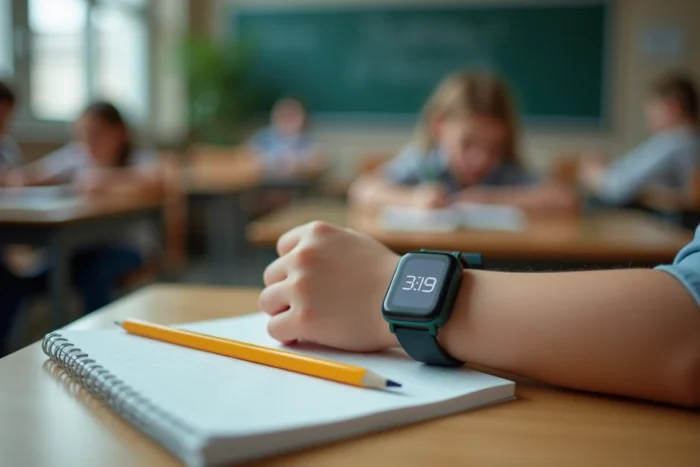
- The school mode, available on most connected watches, disables entertainment functions during class hours. Without this restriction, the child uses the watch as a toy, and the battery drains before the end of the day.
- The parental app permissions deserve verification: limit the list of allowed contacts, disable open Internet access on the SIM card, and enable low battery notifications.
- For models with a SIM card, a plan limited to calls and GPS data reduces the risks of unsupervised use and lowers the monthly cost.
These settings take about fifteen minutes. They transform a gadget into a real safety tool for children.
Actual Cost of a GPS Bracelet for Children Over a Year: Device Plus Subscription
The purchase price represents only part of the budget. Most GPS watches and trackers require a monthly subscription that covers cellular connectivity and access to the tracking app.
Over twelve months, the subscription can amount to a figure comparable to the price of the device itself. Comparing only purchase prices skews the evaluation. Some manufacturers offer discounted annual plans, while others charge monthly without commitment.
Screenless GPS trackers, which are simpler, generally show a lower total cost. However, they do not offer the two-way communication that reassures some parents.
- Check if the subscription includes updates for the parental app or if they are charged separately.
- Compare the cost of replacing the SIM card in case of loss or malfunction.
- Consider the warranty duration of the case, often limited to one year on entry-level models.
Incident Detection: A Function Borrowed from the Senior Sector
The latest models include sensors capable of detecting a fall or sudden shock, then sending an automatic alert to parents. This technology comes directly from emergency bracelets for the elderly.
On a children’s GPS bracelet, automatic fall detection complements the SOS button by covering situations where the child cannot press it themselves. The reliability of this function varies by model: some trigger false positives during normal sudden movements (running, jumping).
This convergence between devices for seniors and devices for children confirms that the market for GPS safety bracelets is evolving towards more active remote monitoring, beyond simple location tracking.
The final choice depends on the suitability between the format (watch, case, bracelet), the actual annual budget, and the level of configuration that parents are willing to maintain. A well-configured device with a reliable battery offers better protection than a high-end model left with its default settings.