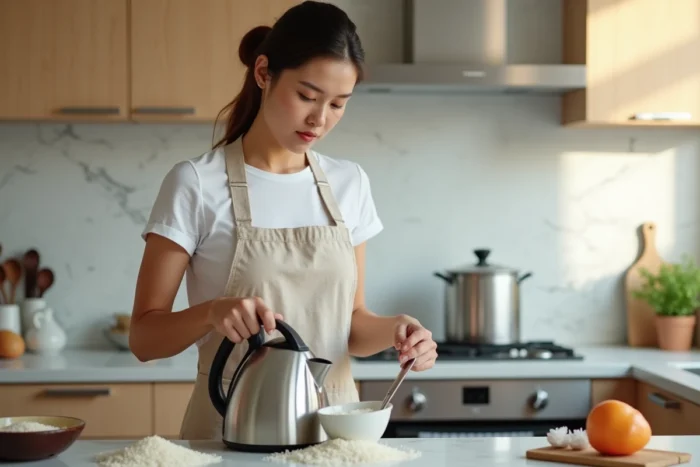
Cooking rice in an electric kettle is a repurposed use that thousands of travelers, students, and workers on the go practice due to the lack of a stove or pot. The principle seems simple: hot water and grains. The technical reality is more complicated, as the kettle was not designed to handle prolonged cooking or a liquid rich in starch.
Bimetallic thermostat and rice cooking: a design conflict
The first obstacle is not culinary; it is mechanical. A standard electric kettle is equipped with a bimetallic thermostat whose sole role is to cut off the power when the steam reaches the sensor. With pure water, the cycle lasts a few minutes. With rice in the pot, the volume of free water decreases rapidly, steam forms irregularly, and the thermostat cuts off before the grains are cooked.
Some models briefly maintain the temperature after boiling, while others cut off abruptly. The difference depends on the type of sensor and the range of the device. On entry-level kettles, the cut-off is almost instantaneous, forcing you to manually restart the cycle several times.
This operation in successive cycles is the key to the method. Each restart brings the remaining water to a boil for a brief interval, and the rice gradually absorbs the liquid between two cut-offs. You should not try to maintain a continuous boil, as the kettle simply does not allow it. You will find other practical tips on Gourmet Galopin to refine this approach cycle by cycle.
Reduced water volume: adjusting proportions to the container
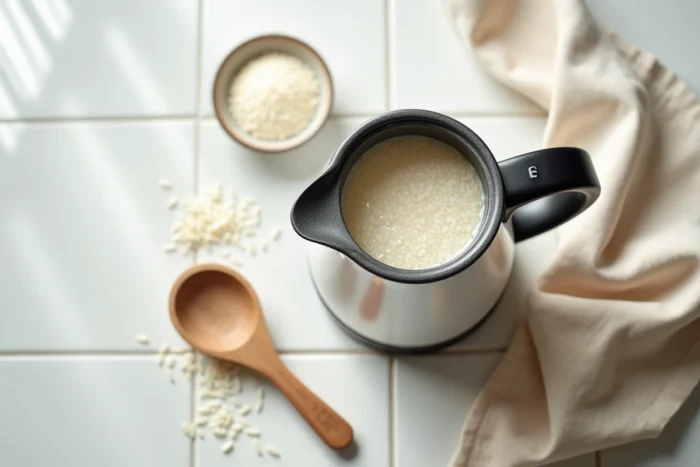
The classic rice cooking guidelines (one volume of rice to one and a half volumes of water, for example) assume an open or covered pot on a regular heat source. In a kettle, the situation changes. The pot is narrow, the lid often poorly fitted, and evaporation between cycles reduces the available liquid faster than expected.
In practice, you need to slightly increase the amount of water compared to the pot method. The margin varies depending on the kettle’s capacity and the type of rice, but planning for a little more water compensates for evaporation between cycles.
Rinsing changes the game
Rinsing the rice before putting it in the kettle reduces the amount of free starch in the cooking water. Excess starch causes two problems in this specific context: it foams the water at boiling (risk of overflow from the spout) and leaves a sticky residue on the heating element.
A rinse with cold water, repeated until the water runs clear, limits these two effects. This step takes less than a minute and reduces the risk of overflow from the spout.
Basmati rice, long grain rice, round rice: not all react the same
The choice of rice variety affects the result as much as the technique. Not all types of rice behave the same way in a narrow container subjected to short boiling cycles.
- Basmati rice, rinsed beforehand, absorbs water evenly and produces separate grains. It is the most suitable variety for cooking in a kettle because it tolerates heating interruptions well.
- Classic long grain rice (parboiled type) works correctly, with a slightly longer cooking time. Its firmer structure withstands the multiple temperature increases.
- Round rice (risotto or sushi type) releases a lot of starch and easily sticks in the pot. Cleaning becomes laborious, and the result is often mushy. It is better to avoid it in this context.
Rinsed basmati rice gives the best results in a kettle. If you only have round rice, a prior soak of twenty to thirty minutes in cold water can mitigate the problem, though it won’t eliminate it entirely.

Water quality and food safety: a neglected point
The water used to cook rice in a kettle almost always comes from the tap. The quality of this water has a direct impact on the result and on the safety of the preparation. The Ministry of Health reminds us that the quality limit for lead in drinking water is set at 10 µg/L since December 2013, in accordance with WHO recommendations.
In older buildings equipped with lead pipes, the first liters drawn in the morning concentrate more metals. Letting the water run for a few seconds before filling the kettle reduces this exposure. This reflex applies to all culinary uses, but it takes on particular significance when the kettle serves both as a heating vessel and a cooking vessel.
Cleaning the kettle after cooking rice
Residual starch and grains stuck to the heating element or the walls must be cleaned immediately after each use. A dried starch deposit becomes hard and difficult to remove without abrasion.
- Rinse the pot with hot water as soon as the rice is transferred to another container.
- Gently scrub the heating element (if visible) with a non-abrasive sponge.
- A diluted white vinegar rinse once a week for frequent use prevents the buildup of limescale and starch.
Never immerse the electric base: only the pot should be washed. This reminder may seem obvious, but compact travel kettles sometimes have an integrated base that complicates cleaning.
Real limitations of the kettle for cooking rice
The electric kettle is a handy solution. It does not replace a rice cooker or even a pot on a stove. The capacity limits portions to one or two people. Temperature control is nonexistent between cycles. And the wear of the heating element accelerates with repeated use outside its intended function.
Field feedback varies on this point: some regular users report no degradation after months of mixed use, while others report accelerated scaling and increasingly early thermostat cut-offs. The lifespan of the kettle may decrease with frequent cooking use.
For occasional use in a hotel room or temporary studio, the method remains reliable and safe if the rice is rinsed, the water is of good quality, and the kettle is cleaned after each cooking session. For daily use, investing in a small travel rice cooker remains the most consistent solution over time.