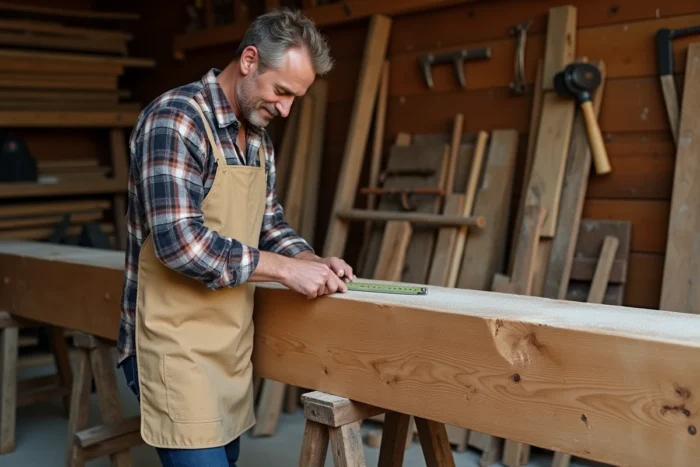
On a span of 6 meters, the sizing of a beam or joist is not simply a matter of applying an empirical rule like “5 cm per meter of span.” This approximation, valid for a lightweight flat roof, becomes dangerous as soon as a floor is loaded or when multiple load descents accumulate on the roof.
The choice of section depends on the type of wood, the nature of the load, the spacing, and the allowable deflection criterion, not on a linear ratio.
Strength class and modulus of elasticity: the two parameters that determine the section
Most online guides compare sections without specifying the strength class of the wood used. A C24 and a C18 of the same section do not carry the same load over 6 meters. The difference in modulus of elasticity between these two classes directly affects the deflection under permanent load.
For solid wood in C24 (spruce, douglas), the bending strength and rigidity allow for working with more compact sections than in C18. We recommend always checking the actual mechanical grading of the delivered batch, as ungraded wood or visually graded wood in ST-II (old standard) may exhibit inferior characteristics.
Before looking for what wood section for a 6m span, it is essential to establish the species and mechanical class. A GL24h glued laminated timber allows for significantly reduced sections compared to solid wood of the same apparent class, thanks to the homogenization of defects through the gluing of the laminates.

Allowable deflection and spacing: sizing the joist for a floor over 6 meters
The deflection criterion is often the determining factor before pure strength. In residential flooring, the allowable deflection is generally limited to 1/300 of the span for comfort. Over 6 meters, this imposes a high rigidity.
The spacing between joists determines the load carried by each element. Reducing the spacing from 60 to 40 cm allows for a decrease in unit section but increases the number of pieces and material cost. We observe that over 6 meters, a spacing of 40 cm often becomes necessary to remain within common sections.
Solid wood joist or I-beam
In solid wood C24, a 6-meter span in floor joisting requires high section heights, often difficult to integrate into a standard floor. I-beams (solid wood or LVL flanges, with an OSB or fiberboard web) offer a significantly better stiffness-to-weight ratio and facilitate the passage of ducts through the web.
LVL (Laminated Veneer Lumber) has a higher modulus of elasticity than solid wood of the same thickness, making it particularly suitable for spans of 5 to 7 meters in joisting. Its cost per linear meter is higher, but the gain in section height often offsets the additional cost in a thickness-constrained floor project.
Load-bearing glued laminated beam: common sections for 6 meters
For a single load-bearing beam supporting joists or a roof over a free span of 6 meters, glued laminated timber is the preferred choice in most cases. Solid wood would require excessively large sections, which are rarely available in sawmills and subject to greater dimensional shrinkage.
- In GL24h with a moderate load (light roofing, steel deck, or mechanical tiles with reasonable rafter spacing), we commonly work with rectangular sections where the height significantly exceeds the width, with the section depending directly on the actual load descent.
- For a floor with partitions and furniture, the load descent significantly increases, and the section must be recalculated on a case-by-case basis. No standard section covers all load cases over 6 meters.
- Supports must be sized to carry the shear force and avoid crushing the fibers. For glued laminated timber, the minimum support length depends on the calculated support reaction and the transverse compressive strength of the wood.
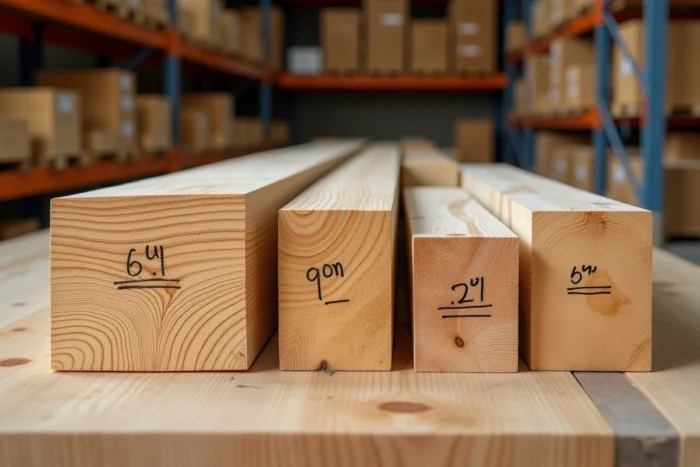
Moisture content and service class: constraints often overlooked on large spans
Wood delivered at a moisture content higher than the intended service class will see its mechanical properties decrease. In service class 1 (heated interior), the wood must be stabilized around 12% moisture. In service class 2 (sheltered but unheated, such as a carport or covered area), the moisture content can increase, and the modification coefficient kmod applied in the calculation reduces the usable strength.
Over a span of 6 meters, this reduction in strength may require a section jump compared to the same structure indoors. For a carport or covered area, we recommend sizing in service class 2, even if the structure seems protected.
Fire regulations and encapsulation
The decree of February 19, 2026, modifies the fire regulations for ERP with wooden structures. For buildings exceeding 8 meters in height, exposed wood must be encapsulated with materials classified A2-s1,d0 (such as plasterboard) or protected to eliminate its contribution to fire development.
This requirement concerns spans greater than 8 meters, but it impacts projects at 6 meters in ERP: exposed glued laminated beams remain permitted below this threshold, provided that the fire stability required by the type of establishment is respected.
- In individual housing, these constraints do not apply directly, but the fire resistance of the wooden structure may be required by the insurer.
- For fire sizing, the standardized carbonization rate of softwood allows for the calculation of the residual section after the required stability duration.
The sizing of a beam or joisting over 6 meters remains a full structural calculation. The formatted section tables found online provide a rough estimate, never a validation. The actual load descent, the strength class of the delivered wood, the chosen deflection criterion, and the service class each set a distinct requirement, and it is the most constraining one that determines the final section.