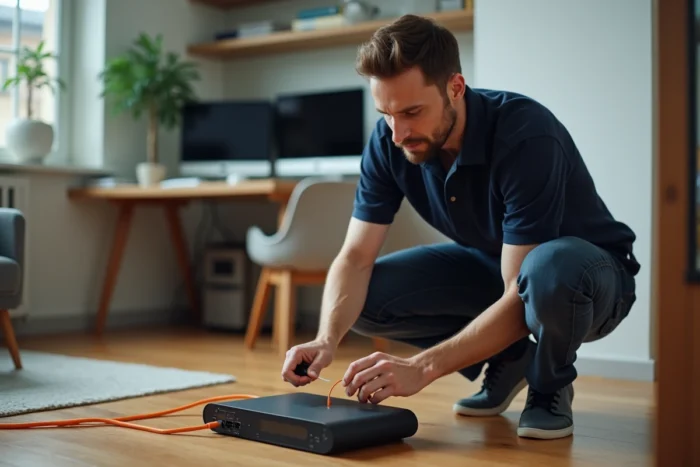
Fiber optics and Wi-Fi are two links in the same chain, but they do not operate at the same level. Fiber refers to the physical connection between your home and the operator’s network. Wi-Fi, on the other hand, distributes this signal inside the home, wirelessly. Confusing the two is like comparing a water pipe with the kitchen faucet: one supplies, the other distributes.
Why a Wi-Fi test does not measure the quality of your fiber
Field reports converge on one point: measuring your connection via Wi-Fi skews the diagnosis of the fiber. A disappointing speed displayed by a wireless speed test may come from the router, the thickness of the walls, interference from neighboring networks, or simply the distance between the device and the box.
To assess the real potential of a fiber line, the test must be done using an Ethernet cable (RJ45), plugged directly into the box. This is the only way to isolate the performance of the fiber link itself. If the speed is correct when wired but poor over Wi-Fi, the problem lies within the local network, not with the operator.
This angle remains underexplored in online comparisons, which still regularly mix fiber quality with Wi-Fi quality. Understanding the difference between Wi-Fi and fiber optics helps avoid this shortcut and make a reliable diagnosis before changing offers or equipment.

Fiber optic cable and Wi-Fi signal: two technologies, two logics
Fiber optics transmit data in the form of light signals through thin glass strands. This technology offers a stable and high speed over long distances, without degradation related to the environment. Copper cable (ADSL) loses performance as the distance from the telephone exchange increases. Fiber does not have this constraint.
Wi-Fi operates via radio waves. Its range depends on the power of the router, the standard used (Wi-Fi 5, Wi-Fi 6, Wi-Fi 7), and physical obstacles between the transmitter and the receiver. A load-bearing wall or concrete floor can halve the Wi-Fi speed or worse.
What the Wi-Fi standard concretely changes
Recent fiber boxes come equipped with more efficient Wi-Fi standards. Operators are promoting Wi-Fi 7 and repeaters to correct dead zones inside homes. The performance experienced on a daily basis often depends more on the quality of the local network than on the fiber link itself.
A Wi-Fi 5 router connected to a very fast fiber line will throttle devices long before the fiber is saturated. In contrast, a Wi-Fi 6 or 7 router will utilize a significantly larger portion of the available bandwidth.
Fiber or 5G box: when fiber is not available
Fiber remains the benchmark for predictable speed and connection stability. Recent comparisons show that the 5G box can provide sufficient speeds for remote work or video conferencing when fiber has not yet been deployed. Starlink also falls into this category of alternatives, with variable performance depending on location.
The available data do not allow for a strict equivalence between these technologies and fiber. Stability remains more variable on wireless or satellite connections, especially during peak usage hours. For a household with multiple devices connected simultaneously (TVs, computers, consoles, smartphones), fiber retains a structural advantage.
- Fiber offers a stable symmetrical speed, less sensitive to weather conditions or local radio network congestion
- The 5G box depends on the coverage of the antenna and the number of users connected to the same cell
- Starlink has higher latency than fiber, with fluctuations related to the position of the satellites
Reliability of the fiber network: maintenance matters as much as technology
Fiber optics are often presented as an intrinsically reliable technology. This is true physically: the glass cable does not suffer from electromagnetic interference and is more resistant to corrosion than copper. ARCEP and industry organizations are working in 2026 on the maintenance of fiber networks in operational conditions and service quality.
This project shows that reliability no longer depends solely on technology. Incidents on fiber networks (cuts, cable degradation, temporary saturations) exist, and their management falls to the maintenance performed by infrastructure operators. A poorly maintained fiber network can provide an experience inferior to a good 5G connection.
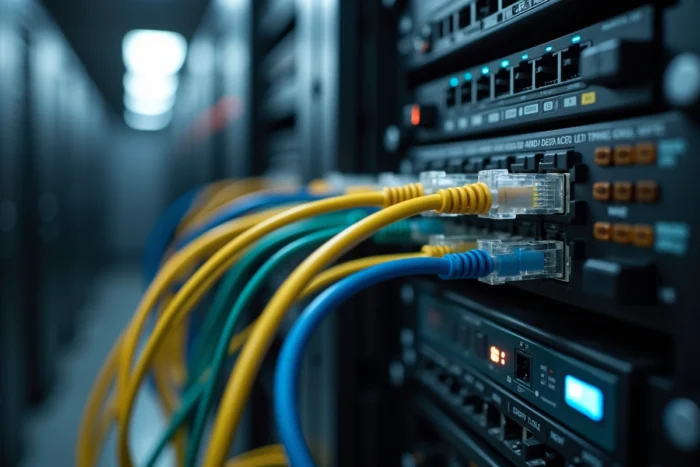
Local network: the often neglected link
Even with a high-performance fiber line, several elements of the home network can degrade the connection:
- An old category Ethernet cable (Cat 5 instead of Cat 5e or Cat 6) throttles the speed between the box and the computer
- A router placed in a closet or basement significantly reduces Wi-Fi coverage
- Devices connected via Wi-Fi on the 2.4 GHz band saturate faster than those on the 5 GHz band, which is less congested
- The absence of a repeater or mesh system in a large home creates areas without coverage
Fast internet connection: fiber and Wi-Fi work together
Opposing fiber and Wi-Fi does not really make technical sense. Fiber supplies, Wi-Fi distributes. A fast and stable connection relies on the quality of both links. Investing in a high-speed fiber offer without checking the state of the local network is like connecting a hose to a new pipe: the bottleneck shifts, it does not disappear.
The most useful reflex remains to test your connection via cable before making any complaints to the operator. If the speed over Ethernet matches the subscribed offer, the issue lies with the Wi-Fi: router positioning, upgrading to a newer standard, adding repeaters, or using powerline adapters as a complement. The quality of the home network determines what each device actually receives.