
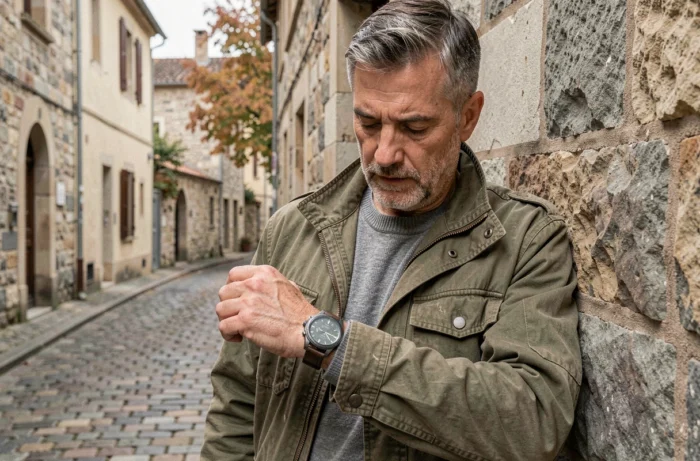
On a construction site, an operating room nurse mechanically turns his watch to the palm side before putting on his gloves. A maintenance technician does the same to avoid scratching the glass against a pipe. This gesture, long confined to the military and a few manual professions, is gaining ground well beyond these circles. The reason is less about a trend and more about very concrete constraints related to daily activities and recent developments in watches themselves.
Smartwatches and adaptive screens: the dial follows the wrist
The inverted wearing style is associated with an aesthetic choice or military habit. In practice, it is often the embedded technology that prompts the case to be turned.
The latest generations of smartwatches incorporate screens that detect wrist orientation and adapt the display accordingly. Some recent patents, particularly from Samsung, describe flexible displays capable of rotating according to the position of the case on the forearm. The dial remains readable whether the watch is worn on the top side or the palm side.
This technical evolution changes the game. With a classic mechanical watch, turning the case meant reading the numbers upside down or getting used to it. With an adaptive screen, the problem disappears. One can choose to wear their watch upside down on the wrist without sacrificing reading comfort, which partly explains the normalization of the gesture.
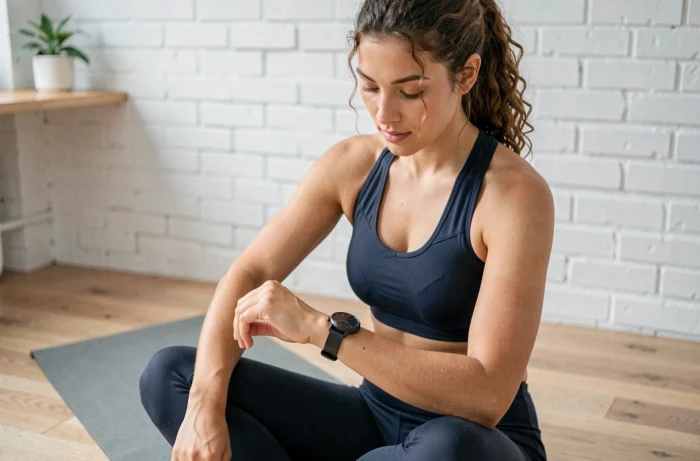
Health sensors (heart rate, oximetry) actually work better when the case rests against the inner wrist, where the skin is thinner and the vessels are closer to the surface. Inverted wearing improves the accuracy of biometric readings on several smartwatch models.
Modern professional constraints: much more than the military
The military explanation remains valid. A soldier in a shooting position reads the time without turning the wrist, and the reflection of the glass does not betray his position. This same reasoning is found among law enforcement and security personnel.
The scope has expanded to civilian jobs where hands are constantly engaged:
- In a hospital setting, caregivers wear the watch on the palm side to avoid injuring a patient during care or contaminating the case by coming into contact with sensitive surfaces.
- In the restaurant and food industry, inverted wearing reduces the risk of snagging the strap on equipment or hitting the glass against a stainless steel work surface.
- Technicians working in confined spaces (plumbing, network cabling, aerospace maintenance) protect the dial by placing it against the forearm, where it suffers fewer direct impacts.
Discretion in professional meetings is another common reason. Checking the time by turning the wrist towards oneself, with a discreet glance, is more acceptable than a wide arm movement. Opinions vary on this point, with some finding the gesture just as visible, but in service and healthcare professions, the practice is well established.
Inverted wearing and case protection: a maintenance reflex
Style is often discussed, but wear and tear is rarely mentioned. Placing the dial on the inner wrist protects the glass and bezel from frontal impacts. When hands are placed on a desk, when grabbing a doorknob, or when handling tools, it is the back of the case (often smooth and uncomplicated steel) that absorbs the shocks.
A scratched glass or a dented bezel is expensive to replace, especially on a quality mechanical watch. Inverted wearing acts as a passive protection, without a case or additional film.
This reasoning also applies to straps. On the inner side of the wrist, the clasp is on top and rubs less against hard surfaces. On a leather strap, this limits premature wear of the most exposed segment.
Wearing a watch upside down as a style code: what the current trend says
The functional aspect does not erase the fashion dimension. We observe a rise in unconventional watch usage as a marker of personal identity, particularly among younger generations.
Wearing the dial on the palm side becomes a deliberate choice, just like layering multiple bracelets or pairing a vintage watch with a contemporary outfit. Inverted wearing signals familiarity with the object, a way of saying that one does not follow the default convention.
Brands are also exploring designs intended for inverted wearing, with indexes and complications readable in this orientation. Inverted movements are the subject of specific horological research, where the mechanism is mounted upside down so that the transparent back becomes the visible face on the outer wrist side.
The market for wearable connected devices is also evolving towards alternatives to the wrist (connected rings, textile sensors), which puts the question of the “correct” wearing direction into perspective. When the wrist is no longer the only possible location for a health sensor, the way a watch is placed becomes more of a preference than a norm.
Choosing inverted wearing: criteria to check
Turning your watch upside down does not suit all models. Before changing habits, a few points deserve attention.
- The position of the crown: on most watches, the crown is at 3 o’clock. In inverted wearing, it ends up on the elbow side and can press against the wrist during flexion. Models with a crown at 9 o’clock or a flat crown are more suitable.
- The weight of the case: a heavy case on the palm side can hinder the grasp of thin objects. Compact or titanium watches pose fewer problems.
- Water resistance and push buttons: in inverted wearing, chronograph pushers risk being accidentally activated against surfaces. Check that the model has a locking mechanism or screw-down pushers.
Comfort also depends on wrist morphology. A flat and wide wrist offers a better fit for the turned case than a round and narrow wrist where the watch tends to pivot.
Inverted wearing is not a whim. Between adaptive screens that eliminate readability constraints, professions that require protecting the dial, and biometric sensors that gain accuracy on the palm side, practical reasons accumulate. Fashion amplifies the movement, but it is ergonomics that initiated it.